

Normals
Surface normals are unit vectors perpendicular to locally estimated surfaces in a lidar point cloud. The SDK computes them from neighboring lidar returns and estimates one normal per valid return from destaggered XYZ and range images.
Users can add normals to frames for visualization, save them for later
processing, or pass them to algorithms such as point cloud registration,
surface analysis, and filtering. Use the normals CLI command to process a
stream of frames, or call the
normals
API when integrating normal estimation into an application.
When used with viz, the visualizer can color the point cloud by the
computed normals while also showing the corresponding image view:
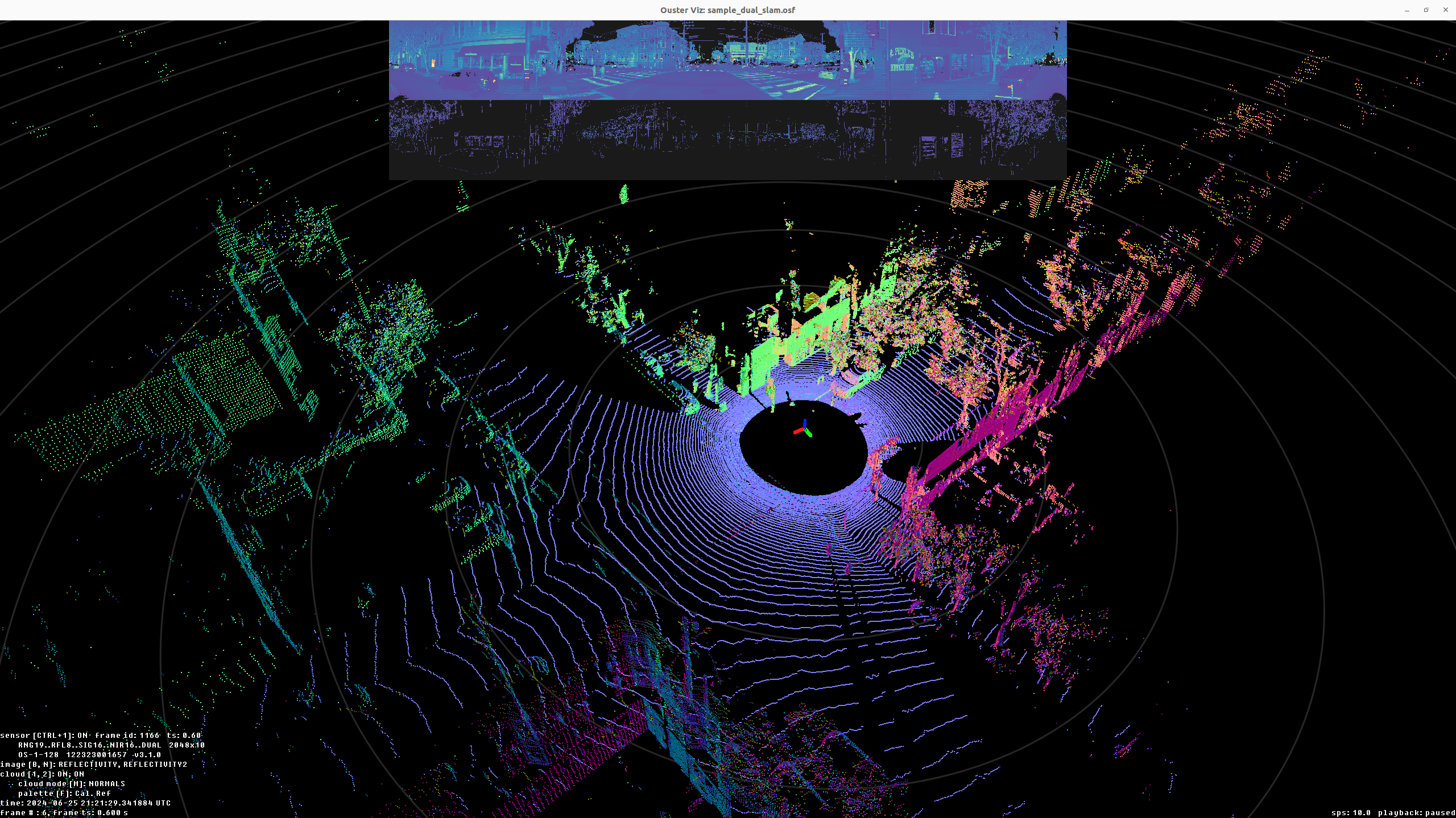
Ouster Viz displaying normals values after running the normals command.
Using the CLI
The chainable normals command computes normals for every frame. It adds a
NORMALS field for the first return and a NORMALS2 field when the second
return is available.
ouster-cli source {OSF_PATH} normals viz
By default, the command dewarps points using the frame poses and expresses the
normals in the global coordinate frame. Use --sensor-coord to compute them
in the sensor coordinate frame:
ouster-cli source {OSF_PATH} normals --sensor-coord viz
Using the API
The
normals
function expects destaggered XYZ and range arrays. XYZ points and sensor origins
must use the same coordinate frame. The examples below use the sensor coordinate
frame, so every sensor origin is (0, 0, 0). See
XYZLut & Destaggering for creating XYZ data and destaggering
lidar fields. LidarFrame fields are stored in staggered layout, so the
examples stagger the computed normals before writing the NORMALS field.
sensor_origins = np.zeros(
    (range_destaggered.shape[1], 3), dtype=np.float64)

normal_image = normals(
    xyz_destaggered,
    range_destaggered,
    sensor_origins_xyz=sensor_origins)
auto sensor_origins = core::MatrixX3dR::Zero(
    range_destaggered.cols(), 3);

auto normal_vectors = algorithm::normals(
    xyz_destaggered,
    range_destaggered,
    sensor_origins);
Invalid returns, or returns for which a normal cannot be estimated, contain a zero vector.